
Gardening and Landscaping in Dulwich
Gardening and Landscaping in Dulwich
Professional Gardening & Landscaping Solutions for Residential, Commercial & Strata Properties Across Adelaide
GET A FREE QUOTE
Dulwich packs about 23 residential streets into 56.7 hectares, and the City of Burnside's own Urban Tree Strategy names the tree planted on nearly every one of them. Jacaranda on Cleland Avenue, Everett Avenue and Mill Street. Desert Ash on Albert Street, Gurney Road and Parkstone Avenue. White Cedar on Grandview Grove, Thornton Street and Williams Avenue. That canopy is what makes gardening here its own job rather than a generic mow: leaf and fruit litter falling onto small blocks, gutters that fill more than once a year, and lawn asked to hold on under closed shade. BP Blitz runs a regular round through these streets, from the Park Lands edge across to Fullarton Road, and we plan a Dulwich visit around the tree out the front instead of pretending it is not there.
OUR STORY
Council Names The Tree On Your Dulwich Street
Most suburbs leave you guessing about the tree on your verge. Dulwich does not. The City of Burnside Urban Tree Strategy carries a street-by-street table for this suburb, and it sets out both the species standing there now and the one Council intends to plant when it goes. Council's own summary of the suburb is blunt about the pattern: Dulwich is one of the first suburbs established in Burnside, its streets have well defined and established housing stock with supporting street tree plantings, and the suburb is dominated by Jacaranda, Melia and Fraxinus species. Read the table and the round almost plans itself. Desert Ash lines Albert Street, Dulwich Avenue, Gurney Road, Parkstone Avenue and Stuart Road, with Claret Ash listed as the replacement. Jacaranda holds Cleland Avenue, Everett Avenue, Mill Street and Swift Avenue, and Council wants it kept. White Cedar stands over Grandview Grove, Thornton Street and Williams Avenue. Queensland Box runs the two arterial frontages on Greenhill Road and Fullarton Road, Golden Rain Tree takes Scott Street, Crepe Myrtle takes The Grove, and Mellington Street has the Illawarra Flame Tree. That is not trivia. It tells us before we quote whether a front garden will be dealing with fine ash leaflets in the gutters, a heavy fruit drop across the lawn, or a shallow-rooted canopy that will fight any new bed for water. It also tells us which streets are due to change character, because Council has flagged Chinese Pistachio and Zelkova as the alternatives across much of the suburb. We use that table the way a builder uses a site plan. A regular garden maintenance round on Thornton Street is not the same job as the identical-looking round on Tudor Street, and pricing it as though it were is how customers end up paying twice: once for the visit, and again for the clean-up nobody allowed for.
SERVICES WE OFFER IN Dulwich
What An Ageing Canopy Does To A Small Dulwich Block
Burnside has been measuring this canopy for a long time, and the record is not flattering. The 1991 street tree survey found around 16 per cent of the city's trees already in decline, mainly through age, with more than 68 per cent of the whole population classed as mature, and it named Dulwich among the suburbs holding the highest numbers of declining trees. The work those trees generated then is the same work they generate now: Council recorded that most of the trees needing attention needed dead-wooding and canopy-lifting to clear the road and footpath. Under that canopy sit some of the smallest gardens on our round. Then there is the fruit. Queensland Health's Poisons Information Centre rates White Cedar, Melia azedarach, as extremely toxic, notes that all parts of the plant are poisonous but the fruits are what people actually eat, and describes fruit 12 to 17 millimetres long that turns brown and dimpled and readily falls from the tree, often while the tree is bare. Burnside plants that species on three Dulwich streets and encourages the low-fruiting variety in future. If you have small children or a dog on Grandview Grove, Thornton Street or Williams Avenue, clearing that drop is a safety task, not housekeeping, and we treat it that way. Pruning is now a legal question too. Since 16 May 2024 a regulated tree in South Australia is one with a single trunk circumference of 1 metre or more measured 1 metre above natural ground, and a significant tree is 2 metres or more, both thresholds having been cut from the old figures. Plenty of mature Dulwich trees crossed into protection overnight. The water side is just as tight. The Kent Town gauge, 1.86 kilometres north-west of here, averaged 510.9 millimetres of rain a year across 2000 to 2024 against 1,379 millimetres of reference evapotranspiration, a deficit of nearly three to one, with 24.4 days a year at 35 degrees or hotter, a 63 day run without a millimetre that broke on 23 November 2023, and only 303 millimetres through all of 2024. Established tree roots take their share first, which is why shallow daily sprinkling fails here and why irrigation has to be zoned to deliver depth.
Why choose us in Dulwich
Why Dulwich Homes And Consulting Rooms Keep Us On The Round
The 2021 Census counted 1,659 people in 741 private dwellings across those 56.7 hectares, and the housing mix is the giveaway. Separate houses make up 70.3 per cent, but 28.5 per cent are semi-detached, row or terrace houses and townhouses, against 14.6 per cent for South Australia as a whole, and 10.3 per cent are one-bedroom homes where the state figure is 3.3 per cent. Add 40.3 per cent owned outright and a median household income of $2,101 a week and you get the pattern we actually work: long-held homes on tight allotments, shared boundaries and common driveways, plus a steady band of offices, consulting rooms and shopfronts along the Greenhill Road and Fullarton Road frontages. Those two groups want opposite things from a gardener. A townhouse owner wants somebody who can get a trailer in and out without blocking a neighbouring driveway. A practice wants the forecourt done before patients arrive and the mess gone before they do. Both get a fixed price written down before anything starts, and the same faces each visit. BP Blitz has traded under its own name since 2023 on a local gardening business with more than 20 years behind it, has looked after over 500 properties across Adelaide, carries 20 million dollars in public liability cover with a certificate of currency on request, and trades under ABN 59 193 634 840. The craft detail matters more on a small block than a large one, because there is nowhere to hide a shortcut. We lay mulch about 75 millimetres deep and hold it back roughly 50 millimetres clear of trunks and stems so collars do not rot, edge beds in galvanised steel where the ground falls away, and set woven weed mesh under pebble so the stone stays where it was placed. Green waste always leaves on our trailer. East Waste collects green organics for Burnside on an alternating fortnightly cycle and is explicit that business, commercial and industrial premises get no additional council bins at all, so on a commercial job here removal is priced into the work rather than left at the kerb.
SERVICES WE OFFER IN Dulwich
The Dulwich Streets We Cover, From Albert Street To Fullarton Road
Dulwich is small enough that one visit covers most of it, which is the main reason a modest job here still prices sensibly. Through the middle we work Cleland Avenue, Dulwich Avenue, Stuart Road, Union Street, Tudor Street, Scott Street, Mill Street and Albert Street past Albert Street Reserve, the street Council singled out as the place it had already trialled water sensitive urban design. North and east we cover Everett Avenue, Swift Avenue, Ascot Avenue, Kitchener Avenue, Parkstone Avenue, Grandview Grove, Victoria Grove, Hillview Street, Dulcie Street, Mellington Street, Thornton Street, Williams Avenue, Gurney Road, The Grove and the two short lanes, Pring Lane and Hector Lane. Those two names are a useful shorthand for the age of what we maintain here. Captain Daniel Pring bought Section 263 out of Colonel William Light's survey, and John Hector, the bank manager who ended up with most of it, subdivided the land and christened it the Village of Dulwich. That subdivision is why front setbacks on these streets are so shallow, and the growth that followed it is why the canopy over them is the age it is: four houses stood here in 1881, and by 1891 there were 50, so the trees planted to shade that first wave are precisely the mature stock Council was recording as declining a century later. Along the southern and eastern edges, Greenhill Road and Fullarton Road are solid commercial frontage now, which is where our commercial property maintenance and strata property maintenance work concentrates, and the ground falls about 30 metres from that Greenhill corner down to the north-western tip on the Park Lands boundary, where South Park Lands Creek leaves the suburb. Seven local heritage places sit inside these streets, at 11 and 15 Cleland Avenue, 64A to 68 Dulwich Avenue, 275 Greenhill Road, 1 Stuart Road, 5A to 5H Stuart Road and 20 Stuart Road. The listing at 1 Stuart Road, Dulwich House, covers the house and a portion of the garden, so it is worth checking before anyone reshapes a bed or takes a tree out at a listed address. We cover the neighbours on the same trip, so Dulwich sits alongside Rose Park to the north, Toorak Gardens to the east, Glenside to the south and Eastwood to the south-west. If your street is not named above, ring 0406 147 913 and ask, because at this size it is almost certainly on the run.
Gardening and Landscaping Services we offer In Dulwich
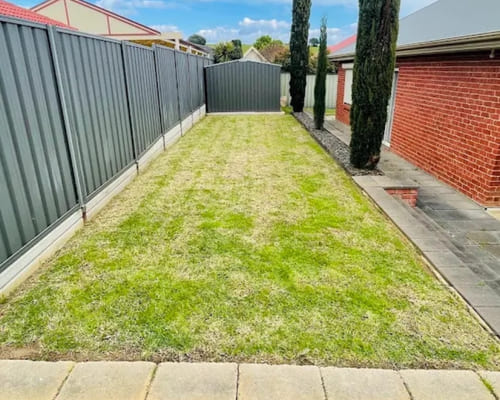
Scheduled mowing you can actually set your calendar by, with edging, trimming and a full blow-down included every visit. Cut height matched to your grass type so your lawn survives the Adelaide summer instead of scalping.
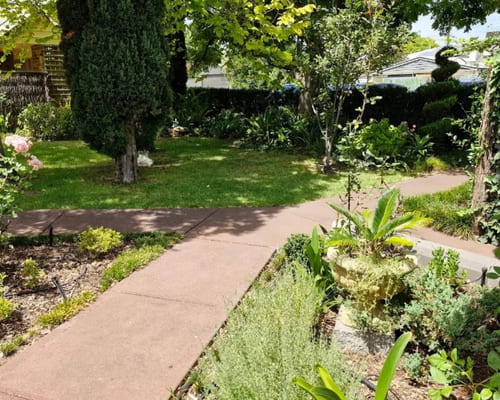
Weeds treated properly rather than just sprayed off the top. Selective lawn treatment, bed hand-weeding, paving knockdown and mulch suppression, timed to the Adelaide season so the weeds do not simply return in six weeks.
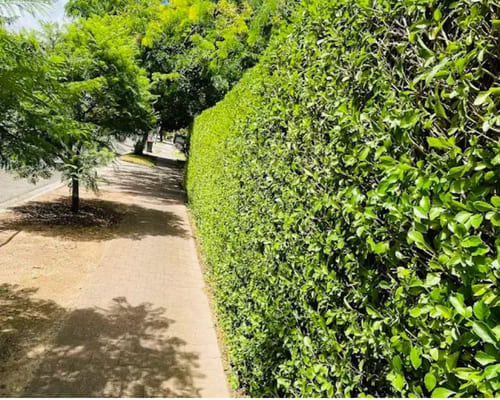
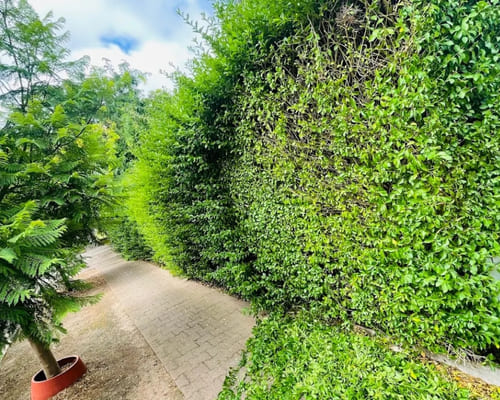
Hedges and shrubs cut to the species and the season, tapered so they stay green to the base rather than going bare and woody underneath. Every trimming cleared away, with the green waste cost agreed before we start.
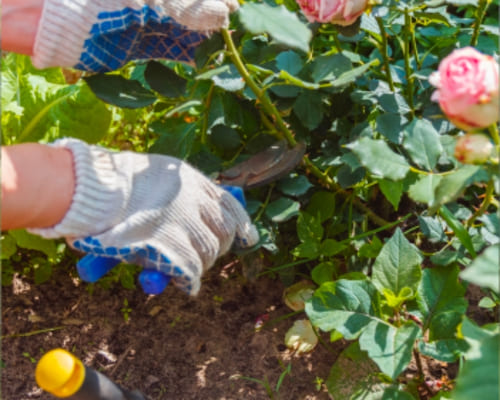
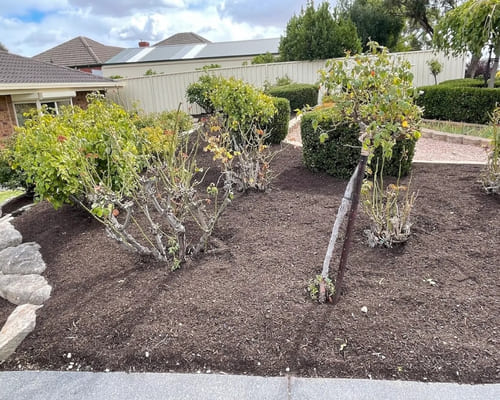
Roses pruned the way they should be, by bush type, at the right time of year, with clean angled cuts to outward-facing buds. An open vase shape that beats black spot and gives you a proper flush of flowers in spring.
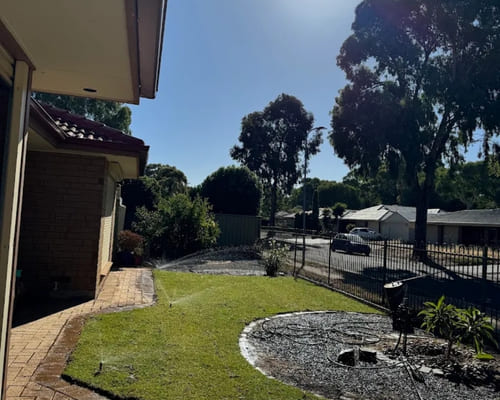
Feeding that actually reaches the roots. We condition Salisbury's reactive clay with gypsum, compost and wetting agents first, then apply the right slow-release or liquid feed for your lawn and beds, timed to the Adelaide seasons.
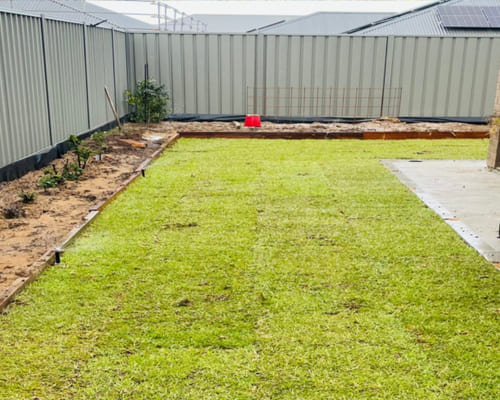
One crew, one schedule, one number that never changes. Mowing, edging, weeding, trimming and green waste handled on a set cycle so your garden never reaches the point where it needs an expensive rescue.
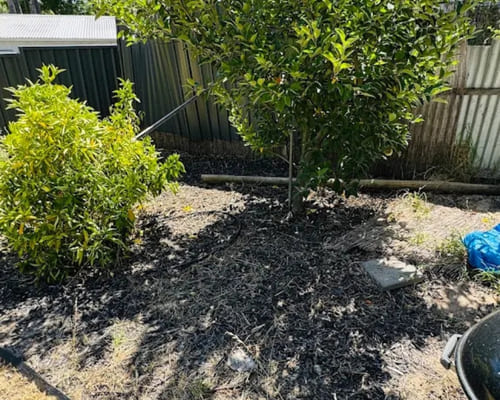
One visit to get a property back under control, quoted in writing before we touch anything. Bond returns, open inspections, council notices and overgrown blocks cleared completely, with the green waste cost agreed upfront.
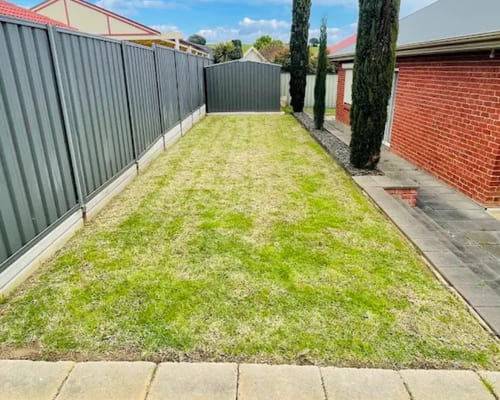
Strata grounds maintained on a fixed cycle with one point of contact, itemised invoicing your committee can approve, photo reporting and a current certificate of currency backed by $20 million public liability cover.
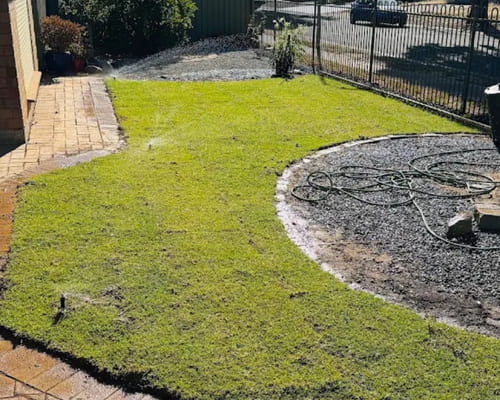
Commercial grounds kept to a consistent standard on a fixed schedule, worked around your trading hours, invoiced against an ABN with itemised lines and backed by $20 million public liability cover.
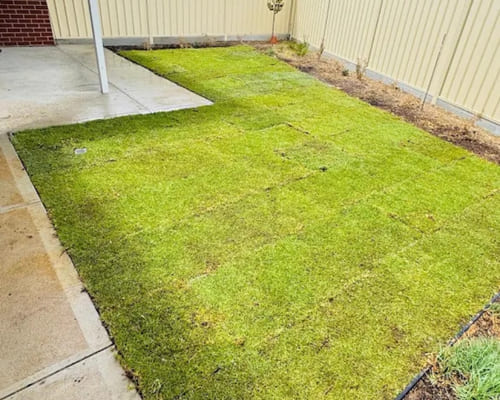
The whole property handled by one crew instead of three separate trades. Lawns, beds, hedges, mulch, irrigation and gutters on a single schedule, with one invoice and one number to call.
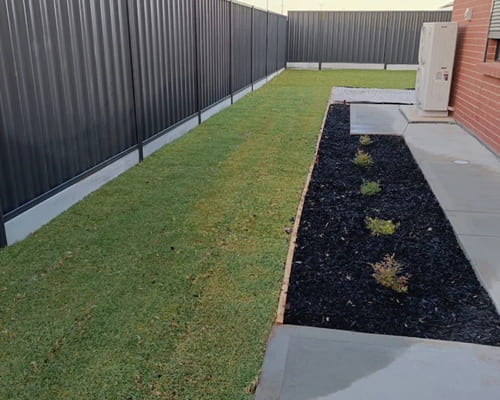
Turf that is still thriving in three years because the clay underneath was fixed first. Gypsum, compost, proper levels and screed sand before a single roll goes down, plus the watering plan that gets you through the critical first three weeks.
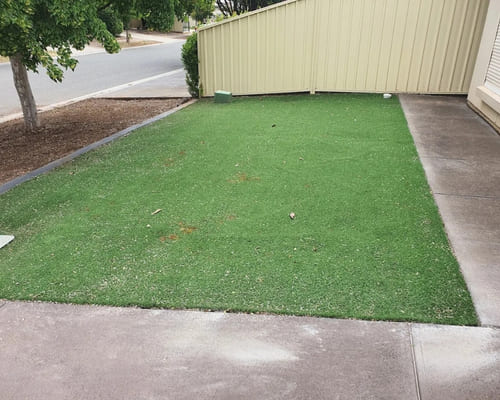
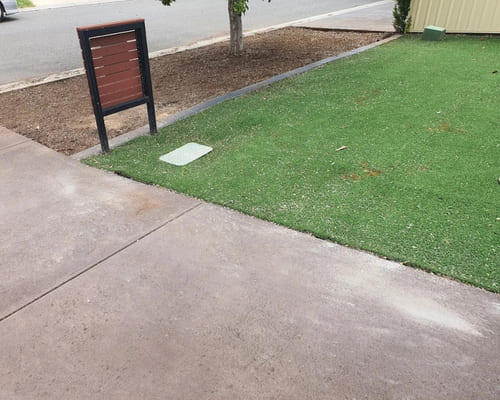
Artificial turf laid on a properly compacted crushed rock base, not straight onto dirt. Glued joints, secured edges and brushed-in infill so it still looks flat and upright after its third Adelaide summer.
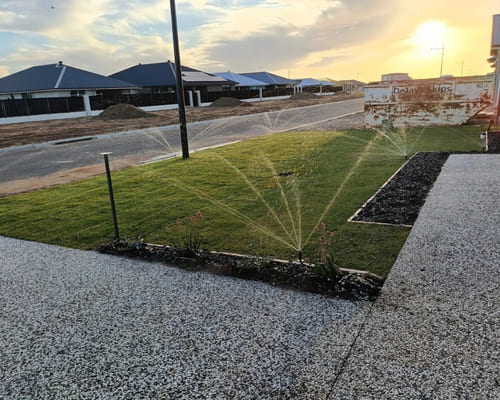
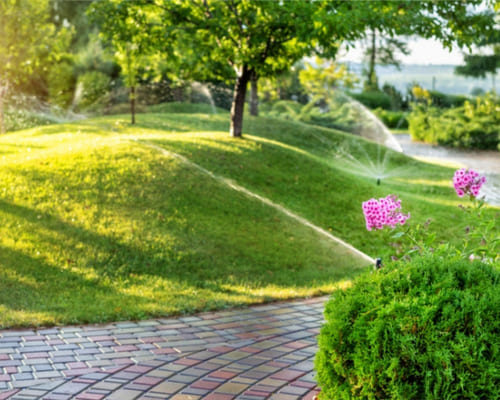
Irrigation designed off your actual mains pressure and flow, zoned by plant type and sun, and set for early-morning cycles that beat Adelaide evaporation. Every arc tested and adjusted before we hand it over.
Gardening and Landscaping In Dulwich
FREQUENTLY ASKED QUESTIONS
Everything you need to know about our Gardening and Landscaping In Dulwich
How much does a gardener cost in Dulwich?
A standard maintenance visit in Dulwich generally runs $60 to $110, and this suburb tends to sit at the lower to middle end of that band because the blocks are small. Nearly three in ten homes here are semi-detached, terrace or townhouse, so a lot of what we do is courtyard scale rather than quarter acre. Where the price climbs is litter volume, not lawn area: a mature Desert Ash or White Cedar over a small front garden creates far more work than the garden size suggests. Catch-up clean-ups are typically $150 to $400 and hedge work is $70 to $120 an hour or quoted for the whole job. Call Mitesh on 0406 147 913 and tell him which street you are on, because that alone tells us most of what we need.
Who maintains the street trees in Dulwich, and can I prune mine?
The trees on the verge are Council's, and the City of Burnside plans them street by street in its Urban Tree Strategy, right down to the species it will plant when the current one goes. You should not be pruning a street tree yourself, and Council takes reports about them on 8366 4200. What sits inside your fence is yours, and that is where we work. Burnside also asks residents to help by maintaining the verge directly adjacent to their property, and runs a separate application if you want to plant or landscape that strip, so check before you start. We are happy to look after the verge grass and the litter that lands on it as part of a regular visit.
Do I need approval before pruning a large tree in my Dulwich garden?
Quite possibly, and the rules got stricter recently. Since 16 May 2024 a regulated tree in South Australia is one with a single trunk circumference of 1 metre or more measured 1 metre above natural ground level, and a significant tree is 2 metres or more, both thresholds having been reduced from the previous figures. Removal or substantial pruning of either needs development approval. A great many mature trees in a suburb Council itself describes as having established plantings will now clear that 1 metre mark. We will measure it with you and tell you honestly whether the job needs approval before we touch it, rather than cut first and leave you with the problem.
Are the berries dropping from the tree on my street dangerous?
If you are on Grandview Grove, Thornton Street or Williams Avenue, take them seriously. Burnside's tree strategy plants White Cedar, Melia azedarach, on those three streets, and the Queensland Poisons Information Centre rates it as extremely toxic, noting that all parts are poisonous but the fruits are what usually gets eaten. The fruit is 12 to 17 millimetres long, turns brown and dimpled when ripe and readily falls, often while the tree has already dropped its leaves. Keep small children and dogs away from a fresh drop and call the Poisons Information Centre on 13 11 26 if anyone swallows any. We clear and remove that fruit as part of the visit on those streets rather than raking it into a garden bed.
Nothing will grow under my Dulwich street tree. What are my options?
This is the single most common question we get in this suburb, and it is a water problem before it is a light problem. The Kent Town gauge just up the road averages 510.9 millimetres of rain a year against 1,379 millimetres of evaporative demand, so an established tree takes its share of soil moisture long before a thin strip of lawn does. Fighting that with daily sprinkling never works. The options that do are a shade-tolerant lawn watered deeply and infrequently, a mulched bed with shade-tolerant planting instead of turf, or artificial turf where the shade is permanent and the traffic is high. We will tell you which of the three suits your aspect rather than selling you the most expensive one.
Do you cover Rose Park, Toorak Gardens, Glenside and Eastwood as well?
Yes. Dulwich is only about 867 metres across and shares a border with Rose Park to the north, Toorak Gardens to the east, Glenside to the south and Eastwood to the south-west, with the Adelaide Park Lands on the western edge. Grouping neighbouring suburbs into one trip is exactly how we keep smaller courtyard jobs worth doing at a fair price. That includes the offices and consulting rooms along Greenhill Road and Fullarton Road, which sit on the boundary and often want a different visit time to the houses behind them. If you are unsure which side of a boundary street you are on, call 0406 147 913 and we will confirm it on the spot.
TESTIMONIALS
What Dulwich Homeowners Say About Us
Request A Free Quote
GET A FREE QUOTE
BUSINESS
SERVICES
OPERATING HOURS
Sun: 7:00am - 9:00pm
Mon: 7:00am - 9:00pm
Tue: 7:00am - 9:00pm
Wed: 7:00am - 9:00pm
Thu: 7:00am - 9:00pm
Fri: 7:00am - 9:00pm
Sat: 7:00am - 9:00pm