
Gardening and Landscaping in Burnside
Gardening and Landscaping in Burnside
Professional Gardening & Landscaping Solutions for Residential, Commercial & Strata Properties Across Adelaide
Burnside is named after a burn. Peter Anderson leased the land in 1839, called his farm Burnside because it sat on the side of Second Creek, and that creek still decides how a garden here behaves. The state soil survey maps this ground as the Knightsbridge Association, soils laid down by First Creek and Second Creek out of eroded Stonyfell Quartzite: a brown sandy loam about 450 millimetres deep, sandy clay beneath it, very little lime, and enough water-worn quartzite cobble through the profile to stop a spade at any depth. So beds and trenches are dug by hand, sand lets water and feed straight through, and the flats beside the creek stay wet all winter while blocks a few streets upslope are dry by December. BP Blitz gardens both halves of it. Call Mitesh on 0406 147 913 for a free measured quote.
GET A FREE QUOTE
OUR STORY
A Village Laid Out In 1849 On 46 Blocks Beside Second Creek
Burnside was farmland before it was gardens, and the shape of the farm is still the shape of the work. The South Australian Company leased the section to Peter Anderson in 1839, and it was William Randall who had the estate agent Nathaniel Hailes lay a village across it in 1849: 134 acres of undulating land cut into 46 allotments of about two and a half acres, 21 of them fronting Second Creek. Those creek-front blocks still hand us the deepest worked soil in the suburb, because the land beside the water at 44 High Street was market-gardened well into the twentieth century and never stopped being turned over. Undulating is the operative word in the rest of it, since the fall across one original allotment is enough to leave the top of a garden dry while the bottom of it stays soft. Henry Warland cut three of those lots into 38 smaller ones in 1877, facing what are now Glynburn Road, High Street, Gartrell Street and John Street, and by 1883 the village held 45 houses with a horse tram running out along Glynburn Road, which is why the old village streets carry narrow frontages and long, hard-to-reach back gardens. The estate gardens that followed have mostly been carved up. Undelcarra, a name chosen to mean under the hill with running water, was doubled in size in the 1880s and subdivided in 1968, though its garden still carries exotic trees planted in that period, and Clifton on Hallett Road, built in 1852, became more than 100 allotments in 1976, so mature canopy now overhangs blocks that were never designed to sit under it. The 2021 Census counted 3,060 residents in 1,148 occupied dwellings, 70.6 per cent of them separate houses and 25.6 per cent semi-detached, row or terrace, meaning a quarter of Burnside gardens a courtyard rather than a quarter acre. A week on this round runs from scheduled maintenance on an inherited estate garden, through hedge and shrub work on a boundary that was once an estate driveway, to a one-off clean-up behind a townhouse off High Street.
SERVICES WE OFFER IN Burnside
Sandy Loam Over Creek Cobble, And The Wet Strip Beside The Creek
The soils here have their own name in the state survey. The Soils and Geology of Adelaide and Suburbs maps Burnside within the Knightsbridge Association, soils it describes as alluvial-colluvial deposits laid down principally by First Creek and Second Creek, sandy in character because those creeks eroded the Stonyfell Quartzite above the suburb. The dominant profile, type RB2, runs brown sandy loam to roughly 450 millimetres, compact reddish-brown sandy loam to about a metre, then red-brown sandy clay carrying quartzite stone, with lime only occasionally visible at depth. That is close to the opposite of Beaumont one suburb east, where a spade finds weathered limestone inside 600 millimetres. Deep sand with little lime lets water and soluble nutrient run past the root zone within a day or two of watering, so fertiliser here means small repeated doses through the growing season, a polymer-coated controlled-release granule rated for three to four months rather than one heavy spring drop of soluble NPK, and a non-ionic wetting agent on any bed that has turned water-repellent over summer. Then there is what the ground itself puts in the way. The survey records considerable proportions of rounded quartzite gravel at random depths, and in the strip beside First Creek and Second Creek it maps water-worn gravel and boulders concentrated at the base of the topsoil. Burnside has been proving that at street level for 150 years: in the 1870s John Sanders walled his Moorcroft property with water-worn stones unearthed while trenching a former creek bed, and sections still stand on the northern side of Young Street, in Rosalind Street and at the front of 470 Glynburn Road, while the stables at Wandeen on Lockwood Road were built largely of the same stone out of Second Creek. A new garden bed or an irrigation trench is therefore quoted on hand digging through cobble, not on a machine rate that assumes clean soil, and we run pressure-compensating dripline rated at 2.3 litres per hour, laid at about 300 millimetre spacings on this sand rather than the 400 to 500 that suits clay. Drainage is where one Burnside address stops resembling another. Next to the creeks the survey maps a variant of the same soil with a grey sandy loam surface, loamy sand below it, mottled clay under that and relatively impervious lower horizons, all caused by a groundwater table sitting close to the surface through winter. Those gardens do not want more water in July. They want fall, raised beds and plants that tolerate wet feet, while a block a few streets up the hill on the same street name is already drying out. Rain makes the split worse rather than better. The same bulletin puts the Waite Institute gauge at 402 feet on 24.5 inches a year, roughly 622 millimetres, against 21.1 inches or about 536 millimetres at the Adelaide city gauge at 140 feet, with evaporation identical at both, so this fringe of the foothills takes noticeably more winter rain onto ground that empties fast in summer. Where that water goes matters too. The First to Fifth Creeks floodplain mapping covers about 60 square kilometres and puts the highest hazard along the creek lines themselves, but it also notes that away from the creeks the flow is shallow and is affected by kerbs, solid fences and landscaping. We keep that in mind before building anything solid across a fall, whether it is a raised bed, a mowing edge or a pebble strip, and we lay composted pine bark or coarse hardwood mulch at 50 to 75 millimetres, held back clear of stems, because anything deeper on free-draining sand simply sheds a light shower.
Why choose us in Burnside
Deciduous Streets, Protected Trees, And Getting The Timing Right
The council street tree plan treats Burnside as a suburb divided by Greenhill Road, separating the lower foothills streets from the plains streets to the north and west, and the planting reflects it. Desert ash runs along High Street, Lockwood Road, Stuart Street and Glynburn Road and is being replaced with claret ash; jacaranda holds Chisholm Avenue, Kings Avenue and Nilpinna Street; white cedar lines Young Street; a nettle tree avenue sits on Waterfall Terrace; grey box is the species on Bradfield Street, Elizabeth Court, Nelson Crescent, Windsor Avenue and Sitters Memorial Drive; and willow myrtle takes Allen Street and Queens Avenue. Ash is the reason autumn in Burnside arrives in your gutters across a fortnight rather than gently over three months, jacaranda adds a second drop of flowers over paths in early summer, and white cedar leaves hard berries sitting in lawn and gravel long after the leaves have gone. There are older trees here that the council list does not cover at all. Remnant grey box still stands in the front gardens between 48 and 56 High Street, survivors of the grassy woodland that covered these foothills before settlement, and a mature eucalypt in a front garden that size means bark and leaf shed all year, surface roots running through the lawn, and a trunk that has almost certainly passed the size at which the law stops you touching it. Since 16 May 2024 a regulated tree in South Australia is any tree with a trunk circumference of one metre measured a metre above the ground, and a significant tree is two metres or more, both needing development approval before anyone touches them. We work inside that: we prune what is lawfully ours to prune, and we say plainly when a job belongs to an arborist and a development application rather than putting a saw into something on a homeowner's say-so. Around all of that, the routine work still has to be timed for this ground. Weed control is scheduled twice a year instead of chased once the seed has set, hedges are cut to a green face so they hold density, and mowing heights come up over summer because a short cut on sand loses moisture faster than the irrigation can put it back. BP Blitz works out of Brooklyn Avenue in Salisbury, carries 20 million dollars in public liability cover with a certificate of currency on request and trades under ABN 59 193 634 840, which is the first thing the agents and body corporates behind our strata and residential property rounds ask for. We have traded since 2023 on a local gardening business with more than 20 years behind it, we have looked after over 500 properties across Adelaide, and every price is fixed and written down before anyone starts. Call Mitesh on 0406 147 913.
SERVICES WE OFFER IN Burnside
Where We Work In Burnside, From The Old Village To The Foothills Streets
Greenhill Road splits our Burnside round the same way it splits the suburb. North of it sits the old village, and that is where the deepest soil and the biggest trees are: High Street, Lockwood Road, Young Street, Allen Street, Gartrell Street, John Street, William Street, Rosalind Street, Norwich Avenue, Penong Avenue, Nilpinna Street and Chisholm Avenue. Down on the creek flats around the Lockwood Road bridge and Moorcroft Reserve, reached off Warren Avenue and Chisholm Avenue, the ground stays cold and wet into spring and we work it later in the season than anything else on the list. East and south the land lifts and the soil thins over stone, and that takes in Garden Avenue, Wyatt Road, Kings Avenue, Queens Avenue, Royal Avenue, Windsor Avenue, Hill Street, Glen Street, View Street, Stuart Street, Zenith Avenue, St Albans Drive, Ringmer Drive, Ifould Drive, Debney Drive, Borrow Drive, Kurralta Drive, Thorpe Road, Berry Crescent, Nelson Crescent, Moorcroft Crescent, Slapes Crescent, Slapes Gully Road, Waterfall Terrace, Sitters Memorial Drive, Undelcarra Road, Newland Road, Finnis Terrace, Elizabeth Court, Bradfield Street, Willowbridge Grove, Windarra Avenue, McAllan Avenue, Hubbe Crescent and the courts off Hallett Road. Bradford Street and Waratah Way sit on the grounds of two of the old estates, so expect mature canopy and root plates where a plan says open lawn. Beaumont is straight over Glynburn Road and often runs the same morning, with Hazelwood Park and Leabrook just north, and Stonyfell and Wattle Park a few minutes east. Erindale, Waterfall Gully and Greenhill adjoin the suburb as well. Call 0406 147 913 with your street name and we will tell you which day we are on your side of Greenhill Road, and whether your block sits on the sand or on the wet.
Gardening and Landscaping Services we offer In Burnside
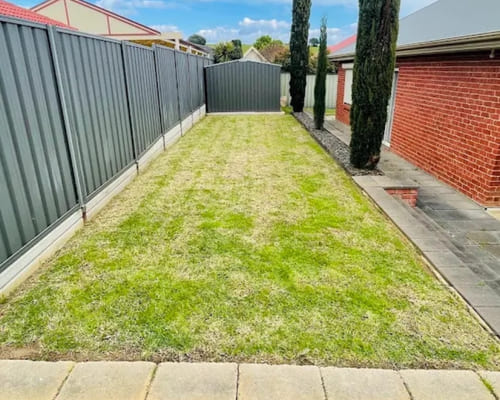
Scheduled mowing you can actually set your calendar by, with edging, trimming and a full blow-down included every visit. Cut height matched to your grass type so your lawn survives the Adelaide summer instead of scalping.
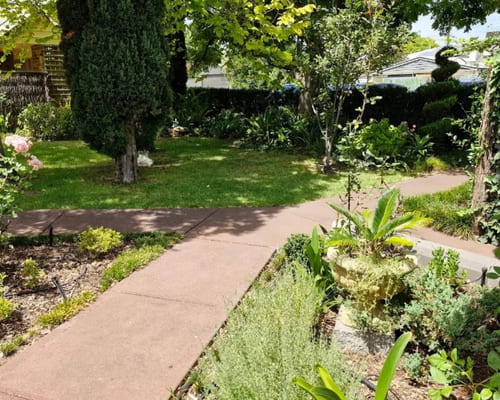
Weeds treated properly rather than just sprayed off the top. Selective lawn treatment, bed hand-weeding, paving knockdown and mulch suppression, timed to the Adelaide season so the weeds do not simply return in six weeks.
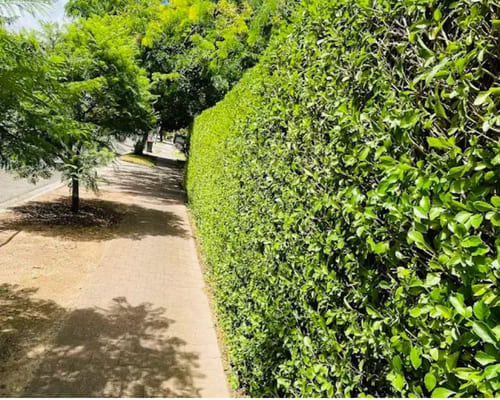
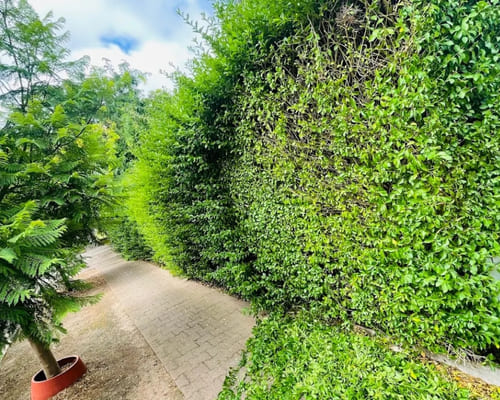
Hedges and shrubs cut to the species and the season, tapered so they stay green to the base rather than going bare and woody underneath. Every trimming cleared away, with the green waste cost agreed before we start.

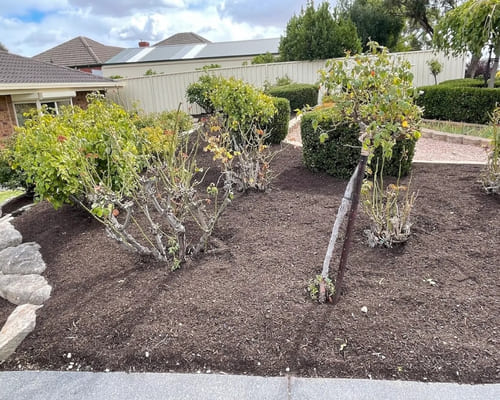
Roses pruned the way they should be, by bush type, at the right time of year, with clean angled cuts to outward-facing buds. An open vase shape that beats black spot and gives you a proper flush of flowers in spring.
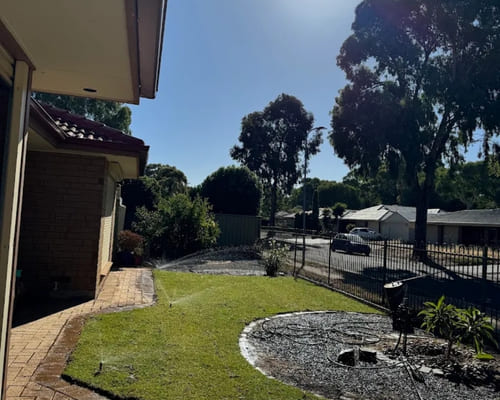
Feeding that actually reaches the roots. We condition Salisbury's reactive clay with gypsum, compost and wetting agents first, then apply the right slow-release or liquid feed for your lawn and beds, timed to the Adelaide seasons.
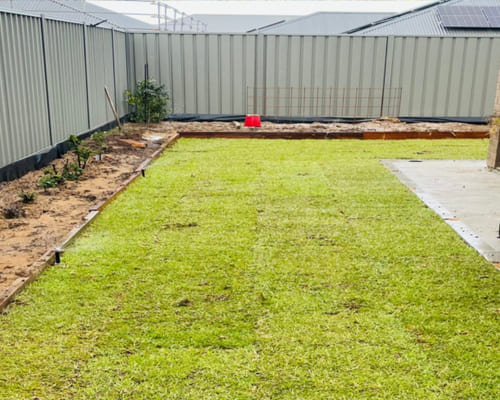
One crew, one schedule, one number that never changes. Mowing, edging, weeding, trimming and green waste handled on a set cycle so your garden never reaches the point where it needs an expensive rescue.
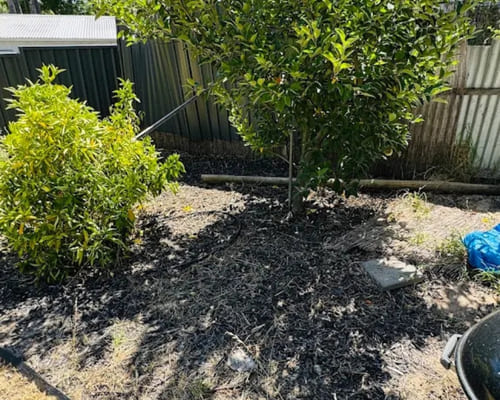
One visit to get a property back under control, quoted in writing before we touch anything. Bond returns, open inspections, council notices and overgrown blocks cleared completely, with the green waste cost agreed upfront.
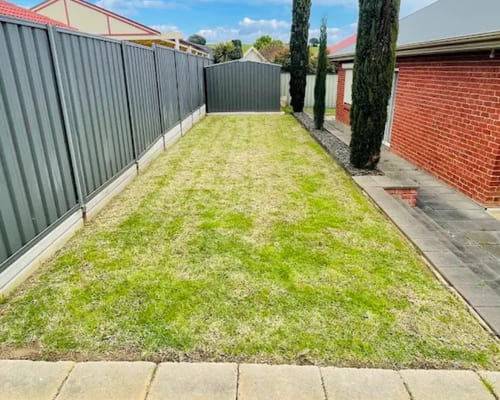
Strata grounds maintained on a fixed cycle with one point of contact, itemised invoicing your committee can approve, photo reporting and a current certificate of currency backed by $20 million public liability cover.
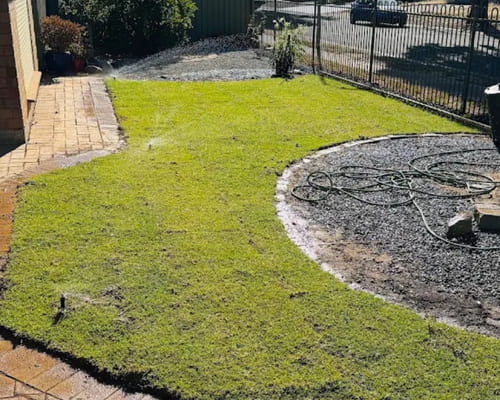
Commercial grounds kept to a consistent standard on a fixed schedule, worked around your trading hours, invoiced against an ABN with itemised lines and backed by $20 million public liability cover.
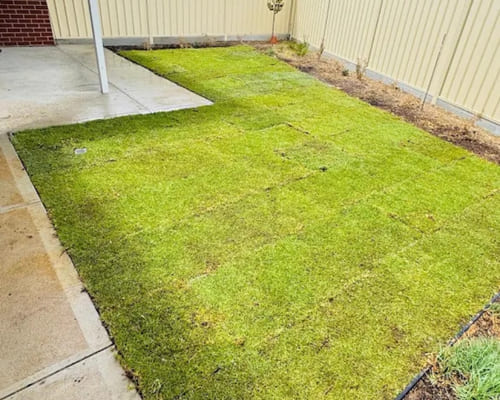
The whole property handled by one crew instead of three separate trades. Lawns, beds, hedges, mulch, irrigation and gutters on a single schedule, with one invoice and one number to call.
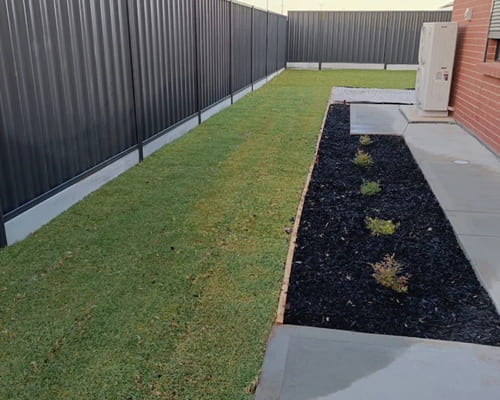
Turf that is still thriving in three years because the clay underneath was fixed first. Gypsum, compost, proper levels and screed sand before a single roll goes down, plus the watering plan that gets you through the critical first three weeks.
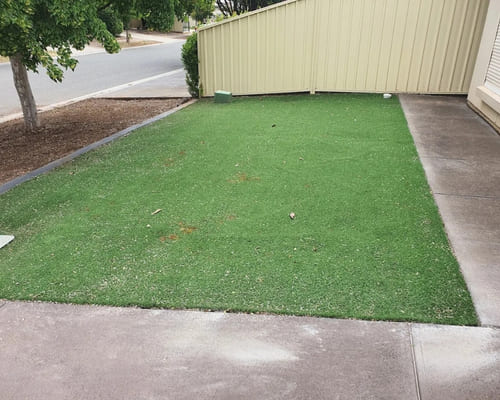
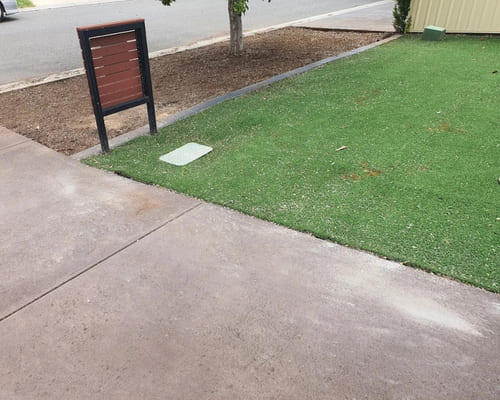
Artificial turf laid on a properly compacted crushed rock base, not straight onto dirt. Glued joints, secured edges and brushed-in infill so it still looks flat and upright after its third Adelaide summer.
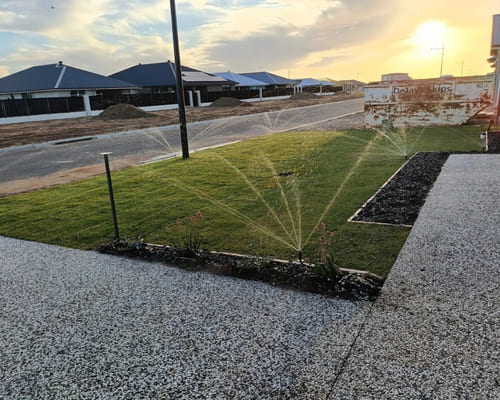
Irrigation designed off your actual mains pressure and flow, zoned by plant type and sun, and set for early-morning cycles that beat Adelaide evaporation. Every arc tested and adjusted before we hand it over.
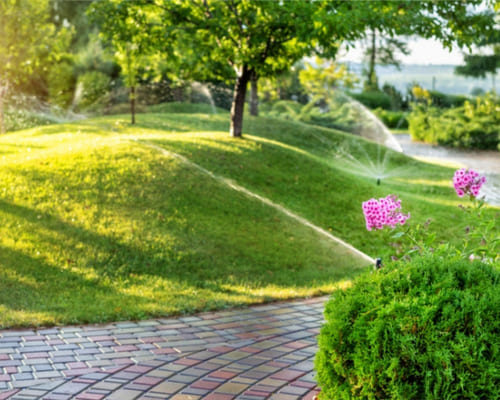
Gardening and Landscaping In Burnside
FREQUENTLY ASKED QUESTIONS
Everything you need to know about our Gardening and Landscaping In Burnside
How much does a gardener cost in Burnside?
A standard maintenance visit on a Burnside block, covering the mow, edging, a trim and the blow-down, generally sits between $60 and $110. The courtyards behind the townhouses that make up a quarter of the suburb are quicker and usually start around $40 to $50, while an old village garden with mature beds, roses and shaped shrubs is horticultural work rather than grass cutting and gets quoted per visit once we have walked it with you. A garden that has been left to run is a clean-up rather than a maintenance visit and normally lands between $150 and $400 depending on how much green waste comes off it, and any digging job carries the cobble in the ground here, which is slower than the same work on the plains. Every figure is fixed and written down before anyone starts. Call Mitesh on 0406 147 913.
Why do I keep hitting round stones whenever I dig in Burnside?
Because you are digging in a creek fan. The state soil survey describes this ground as carrying considerable proportions of rounded quartzite gravel at random depths, washed down by First Creek and Second Creek out of the Stonyfell Quartzite above the suburb, and beside the creek it maps water-worn boulders concentrated at the base of the topsoil. Locals have been dealing with it since the 1870s, when John Sanders built the stone walls that still stand in Young Street and Rosalind Street out of cobble dug from an old creek bed. It is not a fault in your garden. It is the reason we price bed and trench work on hand digging rather than on a machine rate, and the reason a planting plan here allows for the odd hole that has to move a spade's width sideways.
Part of my garden stays soggy all winter and the rest is bone dry by Christmas. Why?
You almost certainly have both of Burnside's soils on the one block. The survey maps a variant beside the creeks with a grey sandy loam surface over loamy sand, mottled clay underneath and relatively impervious lower horizons, caused by a groundwater table sitting close to the surface through winter, while the same association a short way upslope is free-draining sandy loam. The fix is different at each end: fall, raised beds and wet-feet tolerant planting on the low side, and wetting agent, mulch and more frequent shorter watering on the high side. Watering the whole garden on one schedule is what usually kills plants at both ends. We set irrigation zones to match, rather than running the block as one.
My block backs onto Second Creek. Does that change what you can do in the garden?
Yes, in two practical ways. The First to Fifth Creeks floodplain mapping puts the highest flood hazard along the creek lines themselves, and land close to a watercourse carries council development controls, so anything structural near the bank is a conversation with the City of Burnside before it is a conversation with us. Away from the creek the mapping notes that flooding is shallow but that the flow is affected by kerbs, solid fences and landscaping, which means a raised bed, a solid edge or a pebble strip built across the fall can push water somewhere it did not used to go. We keep the fall open, we keep plantings on the bank shallow-rooted and stable, and we tell you if something you have asked for is likely to dam a flow path.
Can you cut back the big tree at the back of my Burnside block?
Sometimes, and we will tell you honestly which case you are in before we quote. Since 16 May 2024 a regulated tree in South Australia is any tree with a trunk circumference of one metre measured a metre above the ground, and a significant tree is two metres or more, and both need development approval before pruning or removal. Plenty of the older grey box, ash and jacaranda in Burnside is over that threshold. Ordinary shaping of shrubs, hedges and smaller trees we do as part of normal maintenance; anything regulated we hand to an arborist and point you at the approval process rather than cutting first and explaining later.
Do you cover Beaumont, Hazelwood Park, Erindale and Stonyfell as well?
Yes. Beaumont sits straight across Glynburn Road and usually runs on the same morning as Burnside, and Hazelwood Park, Leabrook, Stonyfell, Wattle Park and Erindale are all within a few minutes of the same round. Running neighbouring suburbs together is how we keep travel out of the price on smaller jobs, so if you and a neighbour in the next suburb both want a regular cycle it is worth telling us. Call 0406 147 913 with your street name and we will tell you which day we are already in your area.
TESTIMONIALS
What Burnside Homeowners Say About Us
Request A Free Quote
GET A FREE QUOTE
BUSINESS
SERVICES
OPERATING HOURS
Sun: 7:00am - 9:00pm
Mon: 7:00am - 9:00pm
Tue: 7:00am - 9:00pm
Wed: 7:00am - 9:00pm
Thu: 7:00am - 9:00pm
Fri: 7:00am - 9:00pm
Sat: 7:00am - 9:00pm